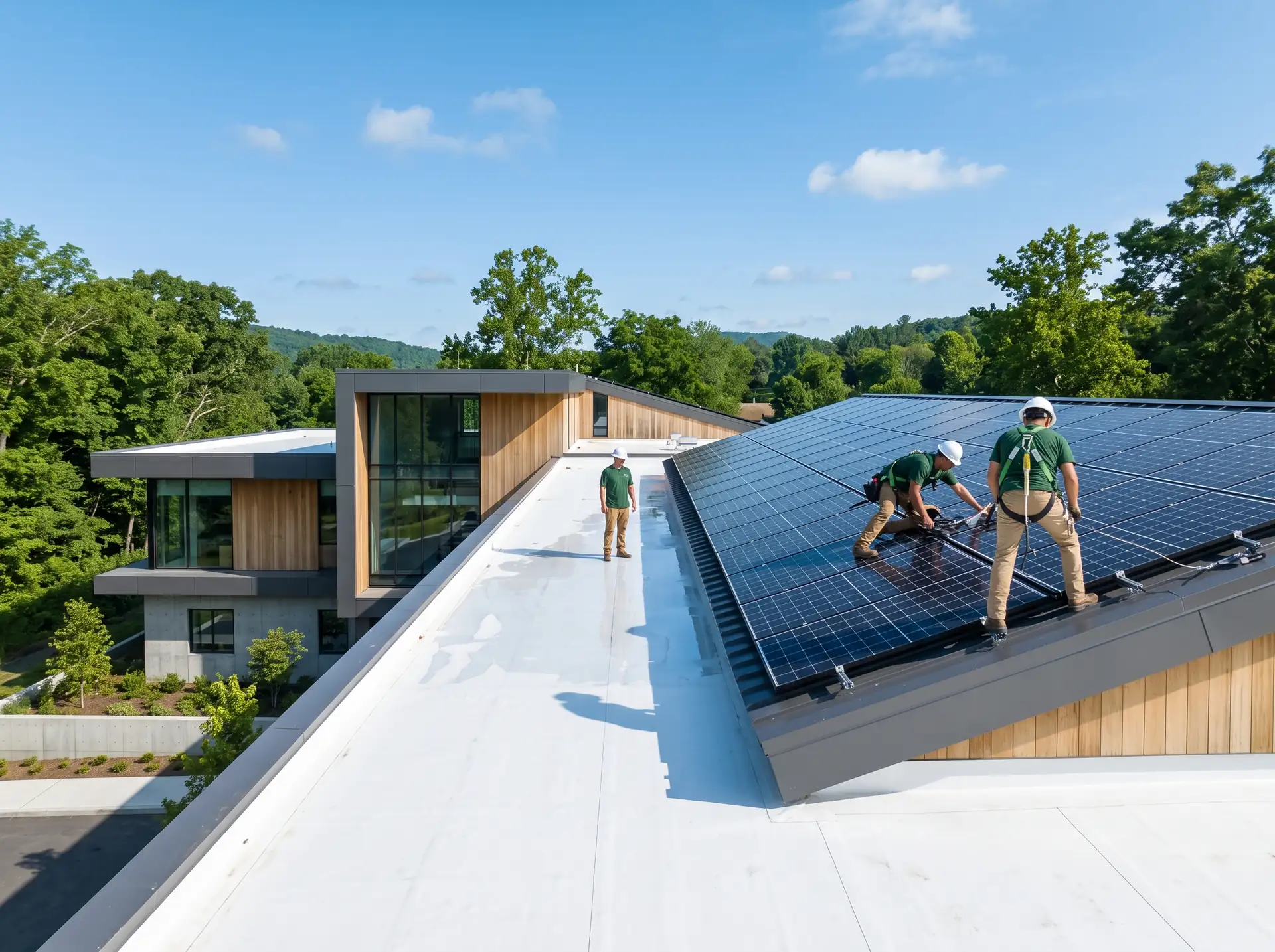
California's cool roof requirements apply when more than half of an existing home's roof is replaced. Under Title 24, Part 6 (Section 150.2(b)1I), a steep-sloped roof in climate zones 4 and 8 to 15 needs a covering with an aged solar reflectance of at least 0.20 and thermal emittance of at least 0.75 (or an SRI of 16). A low-sloped roof in zones 4 and 6 to 15 needs 0.63 and 0.75 (or an SRI of 75).
Several exceptions apply, such as R-38 attic insulation or a radiant barrier for steep roofs. Products must be rated by the Cool Roof Rating Council. The same values apply under the 2022 code and the 2025 code in force for permits applied for from January 1, 2026.
Does the Title 24 cool roof rule apply to your re-roof?
Three questions decide it, and all three have to be answered yes before the cool-roof values apply:
- Is more than half of the roof being replaced? The code applies "where more than 50 percent of the roof is being replaced", and it counts "adding a new surface layer on top of the existing exterior surface" (an overlay) as a replacement. The Energy Commission's own forms say "50% or more", so treat a job at exactly half as covered. Repairs to a smaller area are outside the rule.
- Which climate zone is the house in? California has 16 building climate zones. The rule applies in some of them only, and the list is different for steep and low roofs.
- Is the roof steep-sloped or low-sloped? The code draws the line at a pitch of 2:12. "Steep-sloped" means a rise of 2 or more in 12; "low-sloped" is anything flatter.
New homes have their own, narrower cool-roof rule (steep roofs in zones 10 to 15, low-slope roofs in zones 13 and 15). Do not mix the two up: this guide covers re-roofs of existing single-family homes.
Title 24 cool roof values by roof slope and climate zone
These are the prescriptive values for re-roofing an existing single-family home, quoted from Section 150.2(b)1I of the 2025 Energy Code. The 2022 code has the same values and zones.
| Roof | Climate zones | Minimum aged solar reflectance | Minimum thermal emittance | Or minimum SRI |
|---|---|---|---|---|
| Steep-sloped (2:12 or steeper) | 4 and 8 through 15 | 0.20 | 0.75 | 16 |
| Low-sloped (flatter than 2:12) | 4 and 6 through 15 | 0.63 | 0.75 | 75 |
Solar reflectance and thermal emittance are both measured from 0 to 1; as the Energy Commission puts it, "the higher the value, the 'cooler' the roof." The SRI (Solar Reflectance Index) combines the two and may be used instead of them, calculated from the aged reflectance. Note how far apart the two bars are: 0.20 for a pitched roof, 0.63 for a flat one. Reflectance depends on the exact product and color, so compare the rated value of the color you want, not the product line.
Multifamily and commercial buildings follow different sections with a lower size trigger (more than half of the roof or more than 2,000 square feet, whichever is less) and, for commercial roofs, stricter values.
Need a roof that meets Title 24? Our cool roofing service checks your climate zone and proposes CRRC-rated products for your roof type, with the rated values the Title 24 compliance form asks for.
Which Southern California cities fall in which zone?
The climate zone is set by the building's physical location. The Energy Commission also publishes a list that assigns each ZIP code to one zone, which building departments may use when a ZIP code straddles two zones. For these Southern California cities, the ZIP list gives (before any exception):
| City | Zone (CEC ZIP list) | Steep-slope re-roof needs a cool roof (before exceptions)? | Low-slope re-roof needs a cool roof (before exceptions)? |
|---|---|---|---|
| Pasadena, Altadena (91001), Encino (91316, 91436) | 9 | Yes | Yes |
| Simi Valley (93063, 93065) | 9 | Yes | Yes |
| Long Beach 90805, 90807, 90808 | 8 | Yes | Yes |
| Long Beach, other ZIP codes; Malibu (90263, 90264, 90265); Pacific Palisades (90272); Camarillo | 6 | No | Yes |
| Santa Barbara (93101, 93103, 93105, 93108, 93109, 93110, 93111) | 6 | No | Yes |
The pattern is the useful part. In the coastal zone 6 cities, a typical pitched house re-roof has no Title 24 cool-roof requirement, but a flat or low-slope roof does. In the inland zone 8 and 9 cities, both do. Some ZIP codes straddle a zone line: by our calculation from the Energy Commission's map, parts of Long Beach 90806, 90810 and 90815 lie in zone 8 although the ZIP list says 6, so check the exact address.
Local codes can add to the state rule. The City of Los Angeles, which includes Encino and Pacific Palisades, calls for a rated cool roof when more than half of a home's roof is replaced, in every ZIP code, coastal zone 6 included, with an aged reflectance of 0.25 on pitched roofs and 0.65 on low-slope roofs; LADBS lists a tile lift and relay with no cool roof requirement, and the city's own exception list does not include the Title 24 alternatives such as R-38 ceiling insulation or a radiant barrier.
Unincorporated Los Angeles County, which includes Altadena, sets the same values in Section 4.106.6 of its green building code, with its own exceptions (roof repairs, replacing half the roof or less, building-integrated solar); confirm the details with the county's building office.
How do you find your climate zone?
- Use the Energy Commission's EZ Building Climate Zone Search tool, linked from its Climate Zone Tool, Maps and Information page. Enter the address; the map shows the zone boundary.
- Or check the Commission's Climate Zone Assignments by ZIP Code list. If your ZIP code is split, the building department may apply one zone to the whole ZIP code "at their discretion", so ask which one it uses.
- Your roofer should confirm the zone on the compliance form before you choose a product.
Exceptions: when a pitched roof does not need a cool surface
For steep-sloped roofs, the code treats any one of these as equivalent to a cool roof (Exception 1 to 150.2(b)1Ii):
- Ceiling insulation of at least R-38, or a ceiling assembly U-factor of 0.025 or lower
- A radiant barrier in the attic that meets the code's radiant barrier requirements
- In climate zones 2, 4, 9, 10, 12 and 14, no ducts in the attic
- R-2 or greater continuous insulation above or below the roof deck
Two more exceptions apply to both steep and low roofs. Roof area covered by building-integrated solar (solar shingles or tiles, not panels on racks) is exempt; the Commission clarifies that "only the active photovoltaic area of the roof is exempt". And roof constructions weighing at least 25 pounds per square foot are exempt; the Commission's own example is a sod roof. Do not assume a tile roof qualifies: the product's installed weight decides it.
A project that cannot meet every prescriptive item can instead show compliance with the performance approach, an energy model of the whole house run in approved software.
Low-slope roofs: reflectance, insulation and the trade-off
Low-sloped re-roofs carry two requirements. The first is the 0.63 reflectance. The code lets you trade some of that reflectance for continuous insulation at the roof deck (Table 150.2-E):
| Minimum aged solar reflectance | Deck insulation needed, zones 6 and 7 | Deck insulation needed, zones 2, 4 and 8 to 15 |
|---|---|---|
| 0.60 | R-2 | R-16 |
| 0.55 | R-4 | R-18 |
| 0.50 | R-6 | R-20 |
| 0.45 | R-8 | R-22 |
| No requirement | R-10 | R-24 |
The second is insulation. In climate zones 1, 2, 4 and 8 to 16, the re-roofed area must reach R-14 continuous insulation or a U-factor of 0.039; zones 3 and 5 to 7 have no such requirement. Existing roofs that already have R-10 or more continuous insulation are excepted, as are some others the code lists. A flat-roof replacement is a convenient moment to add insulation, because the roof is open anyway; see flat roofing.
What counts as a cool roof product?
The product has to be rated and labeled by the Cool Roof Rating Council (CRRC). The Energy Commission says the CRRC "is the only entity recognized by the California Energy Commission to determine what qualifies as a cool roof". An ENERGY STAR label alone does not qualify a product, because ENERGY STAR uses different criteria.
Title 24 uses the aged values: the reflectance measured after three years of outdoor weathering, which the CRRC requires for a rating. A product without a rating is assigned default values of 0.08 (asphalt shingles) or 0.10 (other products), which fail both thresholds. You can look any product up in the CRRC Rated Products Directory and filter it by aged reflectance, emittance, SRI and slope.
What paperwork does a Title 24 re-roof need?
For a single-family roof replacement with no field verification, the certificate of compliance is the CF1R-ALT-05-E form; its Section E is "Roof Replacement (Section 150.2(b)1I)". When other work on the permit needs field verification, the registered CF1R-ALT-01-E is used instead. The form is completed and submitted with the building permit application. (Older articles name CF1R-ALT-02-E as the roofing form; in the current code that form covers heating and cooling changes.)
The permit itself is covered in our guide to roofing permits in California.
Does a cool roof actually make a difference?
On hot inland days, yes. The U.S. EPA says "a cool roof absorbs and transfers less heat from the sun to the building", and that in air-conditioned homes the reflectance of a cool roof "can reduce peak cooling demand by 11-27%". The Department of Energy's consumer guide says that in warm or hot climates a cool roof can reduce the annual air-conditioning energy use of a single-story building by up to 15%.
If a solar array is in your plans too, read our guide on replacing your roof before solar.
Other questions
Does the cool roof rule apply to a roof repair?
No. It applies when more than half of the roof is replaced or re-covered. The Energy Commission treats repairs, meaning renewal of part of the roof for maintenance, as outside the scope of the standards.
Can I still have a dark roof in a zone 9 city?
Possibly, in two ways. A darker color complies if the CRRC-rated aged reflectance of that exact product and color reaches 0.20, and a steep roof can skip the cool surface entirely if the house meets one of the listed equivalents, such as R-38 attic insulation or a qualifying radiant barrier.
Do solar panels on racks exempt the roof under them?
No. Only building-integrated solar (the solar product is the roofing) is exempt, and only its active area. The roofing under rack-mounted panels must meet the requirement like the rest of the roof.
Did the 2025 code change the cool roof values?
Not for re-roofs of single-family homes. The 2025 code, which applies to permits applied for from January 1, 2026, keeps the same section number, trigger, zones, values and exceptions as the 2022 code; only table numbers and some wording changed.
Questions about your own roof? Call (323) 760-7835 or request an estimate, and see our cool roofing service for what the work involves.
Sources
- Los Angeles Municipal Code 99.04.106.5, Cool Roof for Reduction of Heat Island Effect
- County of Los Angeles, Title 31 Green Building Standards Code ordinance for the 2025 codes (Section 4.106.6, cool roofs)
- California Energy Commission, Building Climate Zones map layer (Long Beach zone shares calculated by us)
- California Energy Commission, 2025 Building Energy Efficiency Standards (CEC-400-2025-010-F), Sections 100.1, 110.8, 150.2(b)1I, 180.2, 10-113
- California Energy Commission, 2022 Building Energy Efficiency Standards (CEC-400-2022-010)
- California Energy Commission, 2025 Energy Code: effective date
- California Energy Commission, 2025 Single-Family Residential Compliance Manual (CEC-400-2025-005)
- California Energy Commission, 2025 single-family compliance forms (CF1R-ALT-05-E, CF1R-ALT-01-E)
- California Energy Commission, Climate Zone Tool, Maps and Information
- California Energy Commission, Climate Zone Assignments by ZIP Code
- Cool Roof Rating Council, Roof Rating Program FAQs
- Cool Roof Rating Council, Rated Roof Products Directory
- U.S. EPA, Using Cool Roofs to Reduce Heat Islands
- U.S. Department of Energy, Energy Saver: Consumer Guide to Cool Roofs (PDF)
Sources were read on September 30, 2026, with local rules added on October 1, 2026. Codes and maps change; check with your building department for the rules in force at your address.