The 25% rule for roofing is a Florida rule, not a California one. Under Section 706.1.1 of Florida's Existing Building Code, once more than a quarter of a roof or roof section is repaired, replaced or re-covered within 12 months, that whole covering must be replaced or re-covered to the current code; a roof already built or reworked to Florida's 2007 code or a later edition skips that step, and only its new work has to comply. No quarter-roof cap on repairs appears in California's 2025 residential, building or existing-building codes.
What California has are lines at half the roof. Replace more than half of a home's roof and Title 24's energy rules for roofs apply, which can include a cool roof depending on the climate zone; replace half or more within 12 months in the state's wildfire code areas and the roof must be a Class A assembly. Crossing one of these lines changes the specification of a roof replacement, not whether you need one.
Where does the 25% roofing rule come from?
The best-known version is Florida's. Section 706.1.1 of the 2023 Florida Building Code, Existing Building, reads: "Not more than 25 percent of the total roof area or roof section of any existing building or structure shall be repaired, replaced or recovered in any 12-month period unless the roof covering on the entire existing roof system or roof section is replaced or recovered to conform to the requirements of this code."
 Roof Replacement
Three details get lost when the rule is retold. It counts work, not damage: repairing, replacing and re-covering all add toward the 25 percent. It counts across a 12-month period, so several small jobs can add up to one big one. And it can apply to a single roof section rather than the whole house.
Florida has also narrowed it. Under the exception, a roof or roof section built, repaired or replaced to the 2007 Florida Building Code or a later edition needs only the reworked part brought to the current code, and the code adds that Florida law (s. 553.844(5)) bars local governments from amending that exception. The figure is repeated in roofing articles written for readers in many states, so California homeowners hear it too.
Does the 25% rule apply in California?
No. We read the reroofing and repair sections of the 2025 California codes, in force since January 1, 2026: Chapter 9 of the Residential Code, Chapter 15 of the Building Code and Chapters 4 and 7 of the Existing Building Code. None of them caps how much of a roof may be repaired before the whole roof has to be replaced. California's state and local roofing rules put the lines that matter for most homes at half the roof:
 Class A fire-rated roofing
| Rule | Where it applies | The line | What it requires |
|---|---|---|---|
| Title 24 roof rules for homes (Energy Code 150.2(b)1I) | Existing single-family homes | More than 50 percent of the roof replaced (the Energy Commission's forms say 50 percent or more); an overlay counts as a replacement | Cool-roof values on the new roofing: aged reflectance 0.20 on pitched roofs in climate zones 4 and 8 to 15, 0.63 on low-slope roofs in zones 4 and 6 to 15, with exceptions (see cool roof requirements in California) |
| Title 24 for commercial, hotel and motel roofs (141.0(b)2B) | Nonresidential, hotel and motel buildings | More than 50 percent of the roof, or more than 2,000 square feet, whichever is less, replaced, recovered or recoated | Cool-roof values on the new surface in every climate zone, with exceptions; on low-slope roofs, aged reflectance 0.63 |
| Fire rating outside fire zones (Residential Code R902.1.2) | Areas outside Fire Hazard Severity Zones and Wildland-Urban Interface areas | More than 50 percent of the total roof area replaced within any one-year period | The entire roof covering at least Class C |
| Fire rating in fire zones (Wildland-Urban Interface Code 507.1) | State Responsibility Area fire zones, local High and Very High zones, and areas a local agency designates | Half or more of the roof covering replaced in a 12-month period | A Class A fire rated roof assembly, built as a new house would need; barrel tile and other profiled coverings also follow the air-space rule (504.2, 504.2.1) |
| State law in Very High zones (Health and Safety Code 13132.7) | Very High Fire Hazard Severity Zones | More than 50 percent of the total roof area replaced within any one-year period | The entire roof covering at least Class A; the installer gives the owner the covering's fire classification certificate |
| City of Los Angeles cool roof (Municipal Code 99.04.106.5) | Homes anywhere in the City of Los Angeles, in every climate zone | More than half the roof replaced; half or less is exempt | Aged reflectance of at least 0.25 on pitched roofs and 0.65 on low-slope roofs; not required on a re-roof where solar is being installed, or where at least 25 pounds per square foot of mass sits over the membrane, as on a green roof |
Set a 25 percent claim against this table and a home's partial job looks different. Repairing or replacing a quarter of the roof crosses none of these lines on its own: the new work meets the code for that work, and the rest of the roof stays as it is. For a home, only the wildfire code counts exactly half as reaching its line ("50 percent or more"); the other code texts say "more than 50 percent".
 Cool roof requirements (Title 24)
What partial jobs can do is add up. The fire rules count all the roofing replaced over a year, and once the total reaches their line the rating applies to the whole roof covering, not only the newest section: R902.1.2 and Section 13132.7 say so outright, and Section 507.1 has the covering replaced to the new-construction rules. So the California figure that can turn partial work into a whole-roof requirement is half the roof, counted over a year, not a quarter. Before agreeing to a second partial job within a year, ask how much of the roof the two jobs cover together.
Unincorporated Los Angeles County, which includes Altadena, sets the same 0.25 and 0.65 values in Section 4.106.6 of its green building code, and Malibu's re-roof policy points to that county code.
The 2025 Existing Building Code does contain a 25 percent roofing line, and it has nothing to do with damage. When a reroof permit covers more than 25 percent of the roof of a building in Seismic Design Category D, E or F that has parapets of unreinforced masonry, those parapets have to be evaluated or braced (Section 706.3.1). A house without masonry parapets is not affected.
Replacing part or all of your roof? Our roof replacement service starts with an on-site look and photos of what we find, and the written proposal states the full scope, so you can see which of these lines the job crosses.
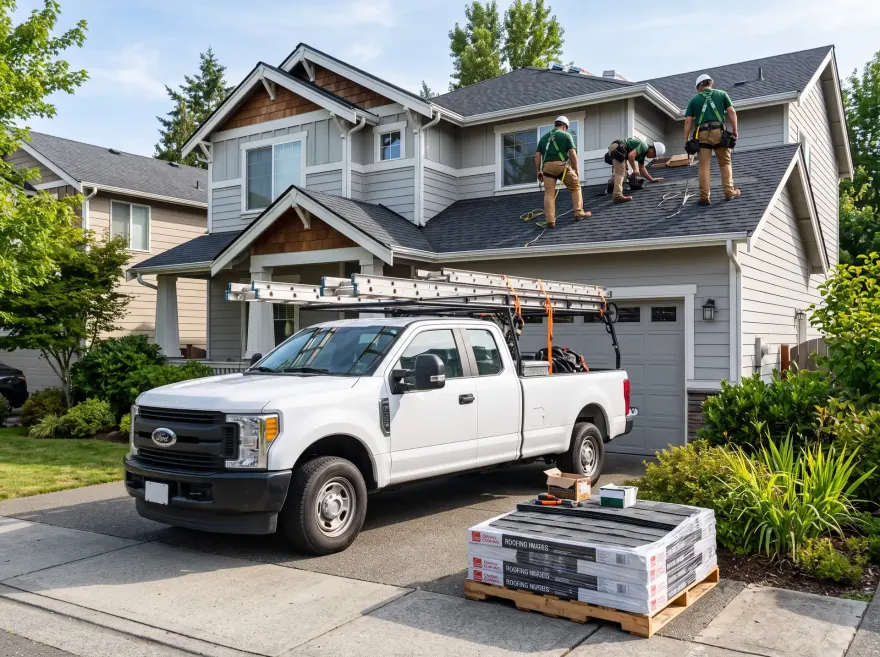 Roofing permits in California
A roofer says 25% damage means a new roof: is that true in Los Angeles?
Not as a code rule. Ask the roofer to name the code section in writing: the 25 percent figure comes from Florida's code, and the California rules that ask more of a re-roof start at half the roof. The number is sometimes used as shorthand for a judgement that repairs are no longer worth it. That judgement can be right for a worn roof, but it rests on the roof's condition, not on a California code section.
Before you decide, ask for these in writing:
- The code section behind any "must replace" statement, by name and number
- The damaged area in square feet, and as a share of the whole roof
- Photos of the damage and of the rest of the roof, so you can see whether the problem is local or spread out
- Any roof work done in the past 12 months, since the fire rules add it to this job
- Whether the address is in a fire hazard zone, and which Title 24 climate zone it is in
In the City of Los Angeles, the lines that matter are a dollar figure and half the roof, not a quarter. The city's Building Code exempts work worth $2,500 or less from a permit, unless it "impacts the structural stability of a building", affects public safety, is done to comply with a Department order or changes the use or occupancy (Municipal Code 91.106.2); the Department of Building and Safety (LADBS) issues the permits.
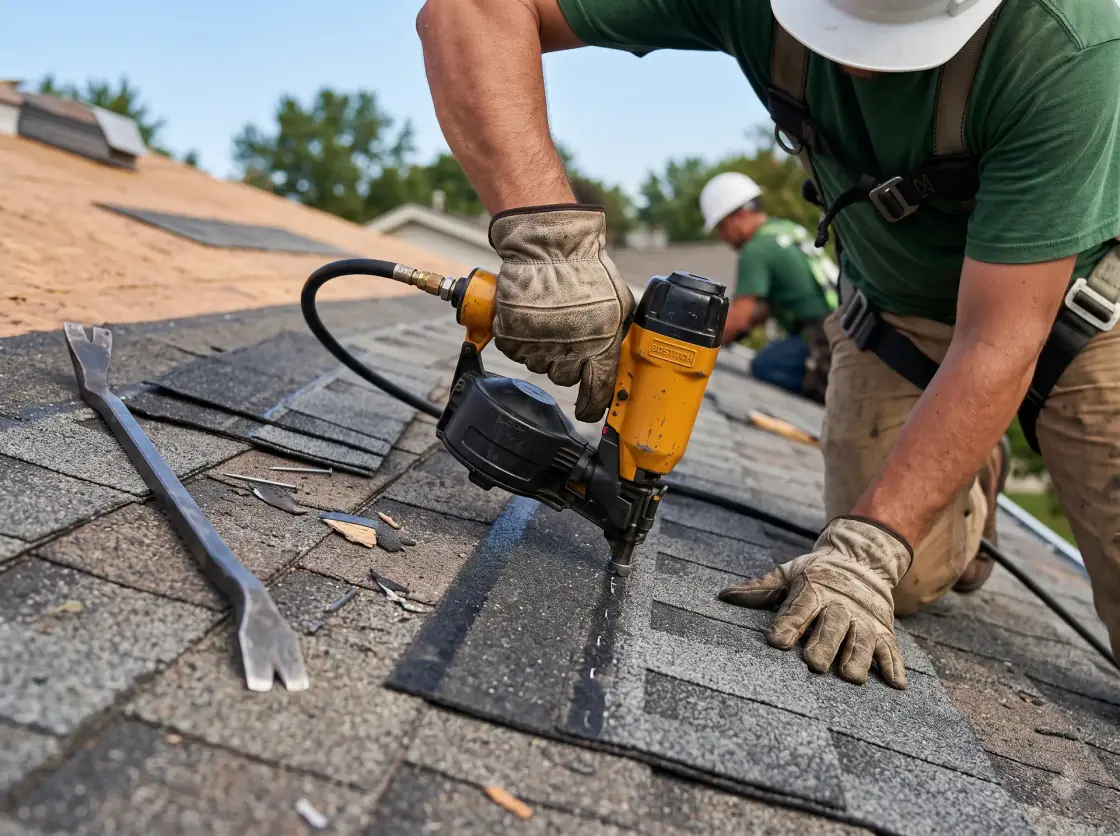 Roof Repair
Once more than half of a home's roof is replaced, the city's cool roof rule asks for an aged reflectance of 0.25 on a pitched roof in every ZIP code, coastal ones included, unless solar is being installed with the new roof. Inside the High and Very High fire zones, replacing half or more of the roof within 12 months calls for Class A. LADBS lists a tile lift and relay, where sound tiles go back over new underlayment, with "Cool roof compliance is not required".
On a roof we look at, the on-site assessment comes first: we show you photos of the roof and the problem areas, and the written proposal lists the system and the full scope, so the size of the job is on paper before anyone talks about a new roof.
Does a repair below half the roof still have to meet the code?
Yes, for the part that is repaired. Staying under half leaves the rest of the roof as it is, but the new work follows the code for that work:
- Fire rating. Any roofing applied in a repair must be at least Class C outside fire zones (Residential Code R902.1.2), and at least Class A where the Wildland-Urban Interface Code applies (Section 507.1).
- Tile. A clay or concrete tile that is "damaged, cracked or broken" cannot be put back on the roof, though sound tile can, and any rusted or damaged flashing around it is replaced (R908.5). Where the exact tile is no longer made, we use salvaged tiles and tell you which before work starts.
- Flashings. Flashings are rebuilt to the manufacturer's installation instructions (R908.6).
- Cool roof. The Title 24 rule does not reach a repair: the Energy Commission treats repairs as outside the standards, and the City of Los Angeles rule exempts roof repairs as well.
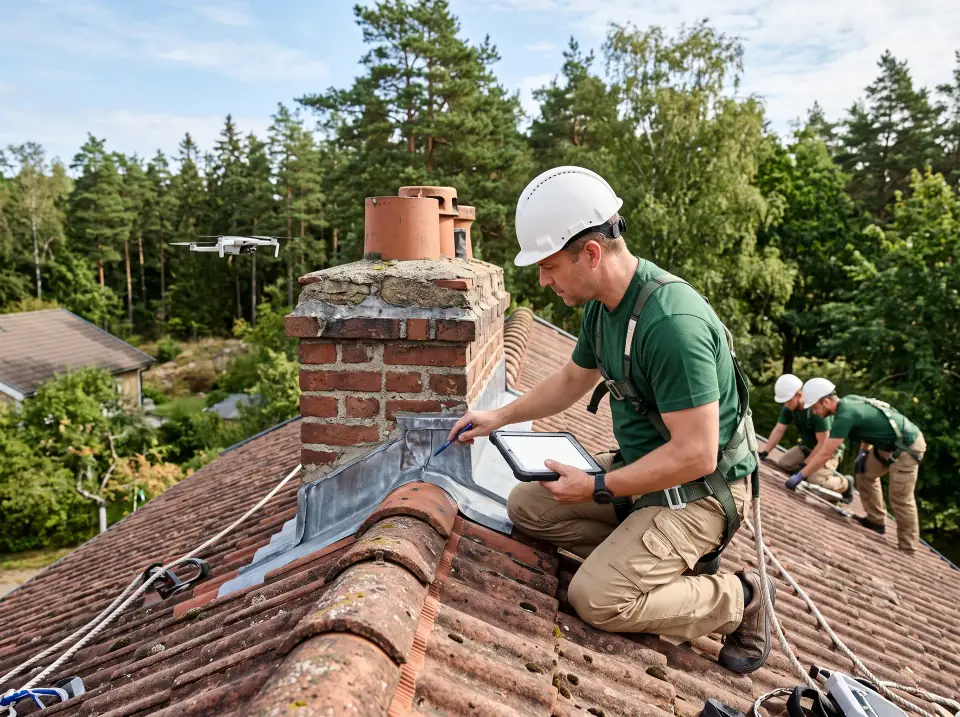 Roof Inspection & Maintenance
Whether the repair needs a permit is set by the city or county, and the lines differ: by value in Los Angeles, by area in Long Beach, and with no size named in Pasadena. Our guide to the roofing permit in California sets them out city by city.
For the work itself, see roof repair, or tile roof repair for clay and concrete tile.
What changes at half the roof in the towns we serve?
Where a house sits decides what replacing more than half of its roof brings. The climate zone sets the state cool-roof rule, two local codes add their own, and the fire hazard map decides whether the roof must be Class A.
A "Yes" in the cool-roof column has exceptions. Under Title 24, a pitched roof can skip cool roofing on a home with at least R-38 ceiling insulation, a radiant barrier in the attic that meets the code, continuous insulation of R-2 or more above or below the deck, or, in zones 2, 4, 9, 10, 12 and 14, no ducts in the attic. Title 24 also exempts roofs weighing at least 25 pounds per square foot.
The two local rules have exception lists of their own, and neither names those attic alternatives. The City of Los Angeles rule does not apply to a re-roof where solar is being installed, or where at least 25 pounds per square foot of mass sits over the membrane, such as a green roof. Los Angeles County's rule, which covers Altadena and which Malibu's policy points to, exempts repairs, a replacement of half the roof or less, building-integrated solar and the same heavy roofs over the membrane; solar panels on racks are not on its list.
Cool RoofingFire-zone shares are land, not homes, and are our own calculation from CAL FIRE's 2025 map data unless the row says otherwise:
| Town | Title 24 climate zone (CEC ZIP list) | Cool roof on the new roofing? (exceptions above) | Fire hazard zones, by our calculation |
|---|---|---|---|
| Los Angeles | 9 for most ZIP codes, the San Fernando Valley included; 8 in South LA; 6 on the coast and harbor; 16 in 91040 and 91042 | Yes, in every ZIP code, under the city rule (0.25) | About a third of the city's land Very High |
| Encino (91316, 91436) | 9 | Yes: Title 24 and the city rule | About 56% of the two ZIP areas Very High |
| Pacific Palisades (90272) | 6 | Yes, under the city rule; the state rule alone would not ask for it | Essentially all of ZIP 90272 Very High |
| Long Beach | 6; 8 in 90805, 90807 and 90808 | Yes in the zone 8 ZIP codes, no in the others | No Moderate, High or Very High zone |
| Pasadena | 9 | Yes | About 28% Very High |
| Altadena (91001) | 9 | Yes: Title 24, and LA County's rule at 0.25 | About 32% Very High, 7% High and 6.5% Moderate; county code asks for Class A in every zone |
| Malibu (90263, 90264, 90265) | 6 | Not under Title 24; the city's re-roof policy asks for CRRC-rated materials under the county code, so confirm the values with Building Safety | Mapped Very High in full by the city; about 91% of its land, the rest mostly federal land |
| Simi Valley | 9 | Yes | About 66% Very High; about 72% High or Very High |
| Camarillo | 6 | No | About 15% Very High, 4% High and 6% Moderate |
| Santa Barbara | 6 (93130 is 5) | No | No share calculated: the city's High Fire Hazard Area, enlarged in 2025, where city code asks for Class A or noncombustible roofing |
Low-slope roofs differ: under Title 24 they need a cool roof on a more-than-half re-roof in climate zones 4 and 6 to 15, so in every zone in the table except 5 and 16. ZIP codes are an approximation, too. By our calculation from the Energy Commission's map, parts of Long Beach 90806, 90810 and 90815 lie in zone 8, and fire zones follow parcels, so look up the exact address on the Energy Commission's climate zone search and the State Fire Marshal's hazard map. Each town page covers its own permit office and local rules.
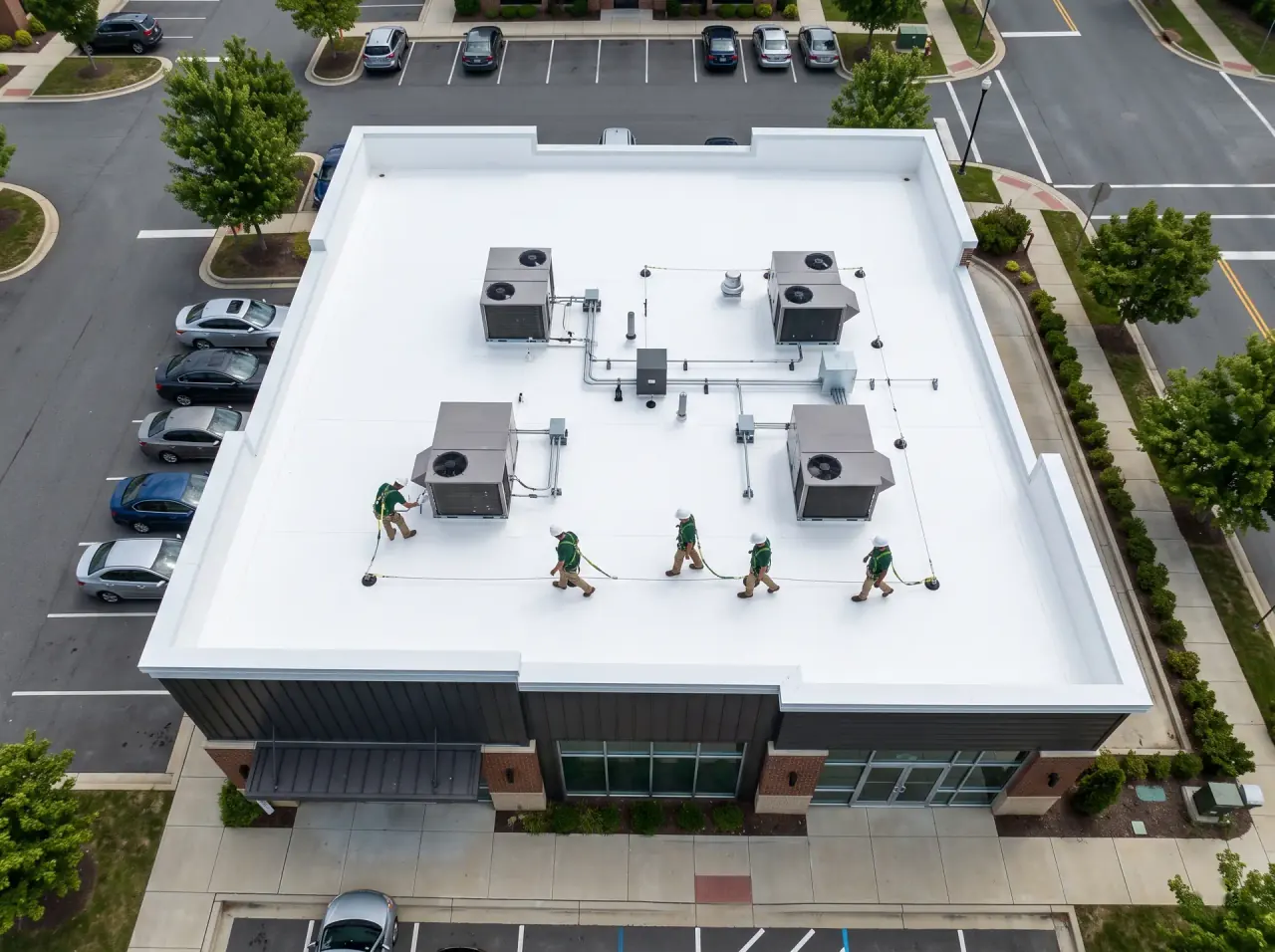 Commercial Roofing
Other questions
Is the 25% rule a California law?
No. The rule is Section 706.1.1 of Florida's Existing Building Code; California's re-roof rules for cool roofs and fire ratings start at half the roof.
Do the 50 percent rules count over 12 months?
The fire rules do. The Wildland-Urban Interface Code counts 50 percent or more replaced in a 12-month period, and Health and Safety Code 13132.7 and Residential Code R902.1.2 count more than 50 percent replaced within any one-year period. Replace 30 percent of the roof in March and another 25 percent in October, and the year's total of 55 percent is past the line under all three. Title 24's cool-roof rule is written as more than half of the roof being replaced; ask your building department how it counts work done under separate permits.
Does replacing half my roof mean I need a cool roof?
It depends on the climate zone, the slope and the attic. Under Title 24, replacing more than half calls for a cool roof on pitched roofs in climate zones 4 and 8 to 15 and on low-slope roofs in zones 4 and 6 to 15 (the Energy Commission's forms say half or more), though on a pitched roof enough ceiling or deck insulation, an attic radiant barrier or, in some zones, an attic with no ducts counts instead. Inside the City of Los Angeles, a re-roof of more than half needs one in every zone, and the city lists no attic alternative; a re-roof where solar is being installed is exempt from the city's rule, though not from Title 24 where its zones reach. Values, exceptions and paperwork.
Questions about your own roof? Call (323) 760-7835 or request an estimate, and see our roof replacement service for what the work involves.