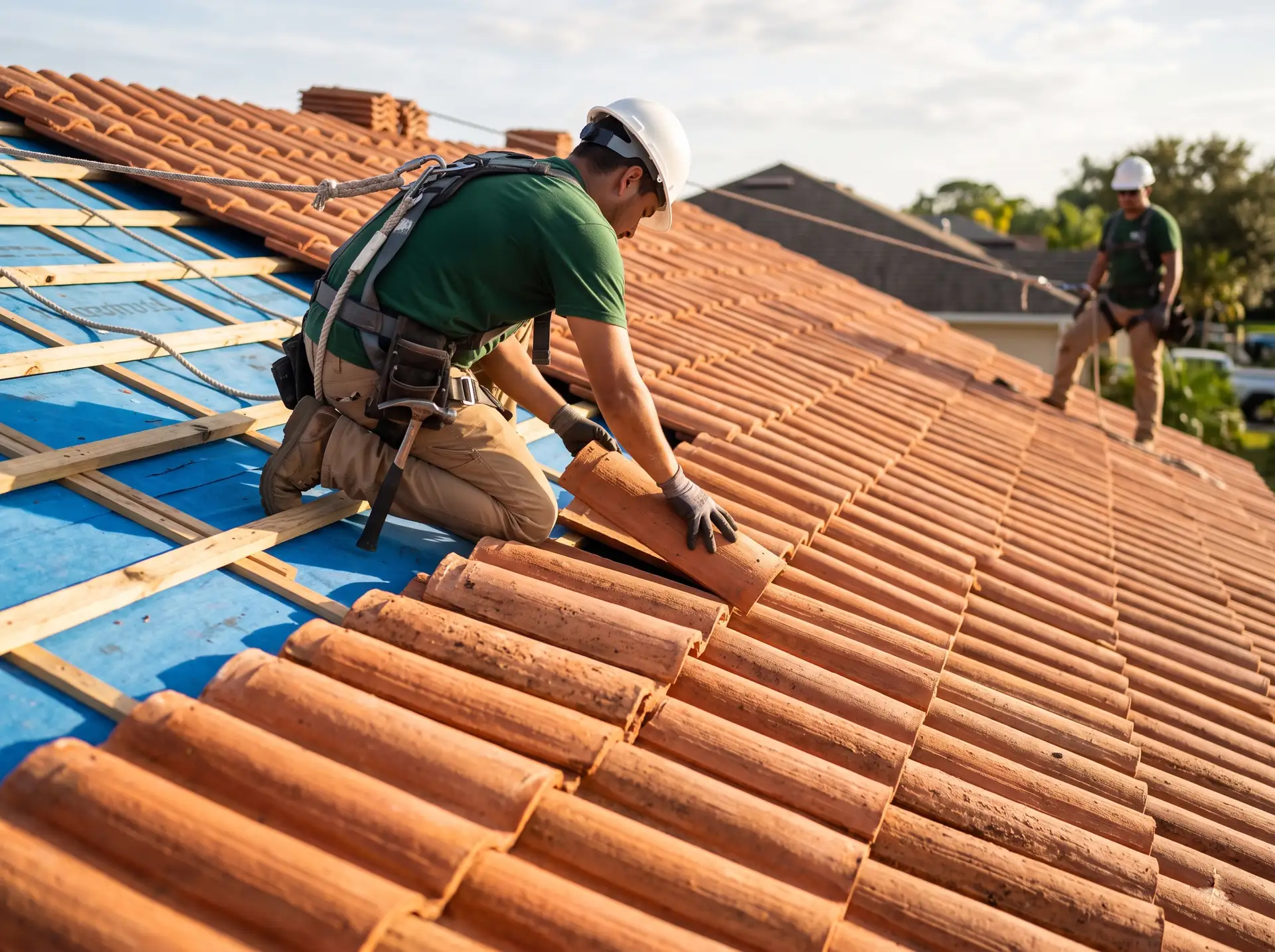
Tile roofing from Global Green Roofing covers new clay and concrete tile roofs and tile re-roofs in Los Angeles. On an existing tile roof whose tiles are still sound but whose underlayment has failed, we lift the tiles, install new underlayment, battens and flashing, and relay the sound tiles. New tile roofs are built the same way from the deck up.
 Tile Roofing
Clay tile vs concrete tile
Both are durable and noncombustible. They differ in look, weight and how they age:
| Clay tile | Concrete tile | |
|---|---|---|
| Made from | Fired clay | Sand, cement and pigment, molded |
| Color | Color fired into the clay body or glaze | Color mixed through the concrete or applied to the surface |
| Styles | Classic Spanish (S), two-piece Mission, flat | Many profiles, including flat and slate or shake looks |
| Installed weight (tile only) | About 800 to 900 lb per 100 sq ft for Spanish barrel profiles (Ludowici data sheets) | About 900 to 970 lb per 100 sq ft for standard tile; lightweight lines about 550 to 720 (Eagle specifications) |
Both need framing that can carry the load and an underlayment system correct for the roof's slope. We help you choose based on the style of the house, the structure and your budget.
Tile re-roof: lift and relay, or new tile?
A tile re-roof starts from one of two situations: the tiles are sound but the underlayment and flashing under them have failed, or the tiles themselves have to go. That calls for one of two jobs:
Lift and relay (underlayment replacement)
The tiles are lifted and stacked, the old underlayment and battens come off, the deck is checked, and new underlayment, battens and flashing go on before the sound tiles are relaid. Broken tiles are replaced with matches. You keep the look of the original roof. The tile roof underlayment replacement guide walks through it step by step.
New tile roof
A complete new tile system, either because the existing tiles are past saving, because you want a different tile, or on a switch from another material. A switch to tile needs confirmation that the framing can carry the weight.
What goes into a tile roof beneath the tiles
A tile roof sheds water in two stages: the tiles take most of it, the underlayment takes what gets past. These are the parts that decide how long it stays dry:
- Underlayment rated for tile and suited to the slope, with extra protection in valleys and at penetrations
- Battens that hold the tiles and let water that gets under them drain down to the eaves
- Flashing at walls, chimneys, skylights and valleys in corrosion-resistant metal; the code requires tile valley flashing to extend at least 11 inches each side of center, with a splash diverter rib
- Eave closure (bird stop) that keeps birds and debris out of the space under the first course
- Ridge and hip tiles set on a support system with ventilation where the design allows
Slope matters too. The California Residential Code allows clay and concrete tile only on roofs of at least 2.5 in 12, and between 2.5 and 4 in 12 it requires a double layer of underlayment (Section R905.3.2). On slopes below 3 in 12, the Tile Roofing Industry Alliance's installation manual treats tile as decorative, laid over a complete membrane roof that does the waterproofing.
Is your house strong enough for tile?
Tile is much heavier than shingles or metal. Replacing tile with tile does not change the load the framing already carries. Switching to tile from a lighter roof does, and it can require an engineer to confirm the rafters and supports, and sometimes reinforcement. We check this before a switch is priced, not after.
Tile, wildfire and the cool-roof rule
Clay and concrete tile are noncombustible and reach a Class A fire rating when installed as a rated assembly, which fire hazard zones require on a re-roof. On a wood deck, California's fire code also asks for a 72-lb cap sheet under the air space that profiled tile leaves, and the eave openings under the first row need closing off against embers; our Class A fire-rated roofing guide covers what the code asks for.
On the energy side, a tile re-roof in an inland Title 24 climate zone faces the same cool-roof rule as any pitched roof. The code exempts only roof constructions weighing at least 25 pounds per square foot, so the tile's actual weight decides that, not the word "tile". Cool-rated tile colors, or the attic-insulation and radiant-barrier alternatives the code lists, are the usual ways to comply; cool roofing covers the options.
Leaks and broken tiles on an existing roof
Tile roof repair covers cracked and slipped tiles and local leaks, without a full re-roof.
How tile roofing works with us
Inspection
Tiles, flashing, valleys and, where tiles can be lifted, the underlayment itself.
Recommendation
Lift and relay or a new tile roof, with photos and a written scope.
Permit
Tile re-roofs need a permit and inspection; the permit is in place before the tiles come off.
The work
Careful tile handling, new underlayment, battens and flashing, and matched replacement tiles.
Tile Roofing questions
Can you reuse my existing tiles?
Usually, yes. In a lift-and-relay job every sound tile is reused and only broken ones are replaced, matched in profile and color as closely as available products allow.
How long does tile underlayment last?
We found no lifespan in years in the California code or the Tile Roofing Industry Alliance installation manual. It depends on the underlayment type, the slope, and how often broken tiles have left it exposed to sun and water, which is why the underlayment is inspected rather than guessed from the roof's age.
Can I switch from shingles to tile?
Often, but only after confirming the framing can carry the extra weight. That may need an engineer and sometimes reinforcement, which is part of the proposal.
In Santa Barbara, design guidelines call for two-piece clay tile in El Pueblo Viejo and on prominent traditional homes, which shapes any tile re-roof there. Other cities are on our service areas page.